Landed Cost for Imported Snacks: From Carton to Shelf Price
A practical walk-through of landed cost for imported snacks, starting from real carton data and ending with a shelf price you can defend to your finance team.
Read more
Export
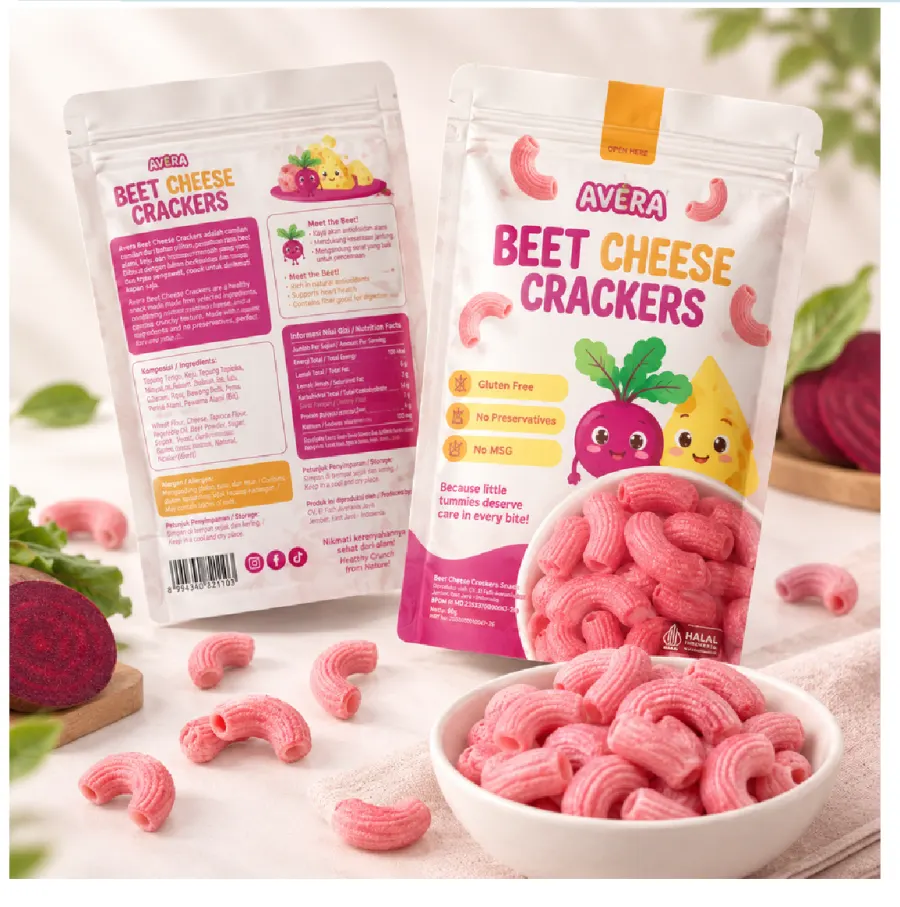
When a specification sheet lists the pack as "PET / ALU / LLDPE", most buyers nod and move on to price. That is understandable, but the pouch is doing more work than almost anything else on the sheet. For a crunchy, fried snack, snack packaging in PET/ALU/LLDPE is largely what decides whether the product tastes the same in month eleven as it did the week it was sealed, and whether it survives a sea container, a humid warehouse and a busy shop floor.
This guide explains what the three layers do, why they matter even more for a preservative-free product, what they mean for shipping and storage, and the honest trade-offs you should weigh before you commit a range or a private-label project to this format.
The pouch is a laminate: three thin films bonded together, each chosen for a different job. Read from outside to inside, the order on the spec sheet is the order of the layers.
| Layer | Main job | What it means for you |
|---|---|---|
| PET (polyester), outer | Print surface, stiffness, scuff resistance | Sharp graphics that hold up in cartons and on shelves; helps a stand-up pouch keep its shape |
| ALU (aluminium foil), middle | Barrier against oxygen, moisture and light | The layer that protects crunch and slows the oil in a fried snack from going stale |
| LLDPE (linear low-density polyethylene), inner | Food-contact layer and heat seal | Strong, flexible seals that resist splitting when the pouch is squeezed or dropped |
None of these layers is unusual on its own. The point is the combination: printability on the outside, a near-complete barrier in the middle, and a reliable seal on the inside.
A fried cracker has two natural enemies once it leaves the line. The first is moisture. Crisp snacks are dry, and they pull water out of the air readily; in a humid climate, a weak barrier lets that happen slowly over weeks until the bite turns soft and leathery. The second is oxidation. The oil in a fried snack reacts with oxygen, and light speeds the process along, which over time shows up as flat or stale, sometimes cardboard-like, flavours.
Clear or metallised films reduce these problems to varying degrees. A continuous foil layer is generally regarded as one of the most effective flexible barriers against all three of oxygen, moisture and light at once, because it is opaque and has very low permeability compared with plastic films alone.
This matters even more when a product contains no preservatives. AVERA Beet Cheese Crackers are made with natural cheese, fresh beetroot and gluten-free cassava flour, fried in pure coconut oil, with no preservatives, synthetic colours, artificial sweeteners, flavour enhancers or artificial texturisers. Without additives doing some of the protective work, the pack has to do more of it. The stated shelf life of 12 months is based on the product in its 50 g PET/ALU/LLDPE stand-up pouch, so if you change the material, you should expect the shelf-life conversation to start again.
Buyers sometimes assume that a good barrier guarantees perfect texture. It helps a great deal, but it is only part of the picture.
A useful habit during evaluation is to check seals and texture on samples that have travelled, not only on those handed over at a meeting. The pack's real test is the journey.
Packing data is where packaging choices turn into freight costs. For AVERA's standard format, the figures are:
Snacks are a light, bulky category. You are mostly shipping volume, and a portion of that volume is the air inside each pouch, which also cushions the crackers. That is why it is worth asking your forwarder to work out pallet and container loading from the carton dimensions rather than from weight. The full export packing details sit on our export page.
On the receiving side, a few habits protect what the pouch has preserved:
No packaging format is right for every buyer, and foil laminates have real limitations you should weigh.
Recyclability. Multi-material laminates are difficult to recycle in most current collection systems because the layers are hard to separate. If your retail customers have packaging targets, discuss this openly and early rather than discovering it at listing stage.
No product window. Foil is opaque, so shoppers cannot see the pink, macaroni-shaped crackers inside. Good photography and clear design on the PET layer have to do that job instead.
Changing the material changes the risk. Lighter or clearer structures may suit some channels, but they usually offer less barrier. Any change should be treated as a new specification, with its own shelf-life expectations agreed in writing.
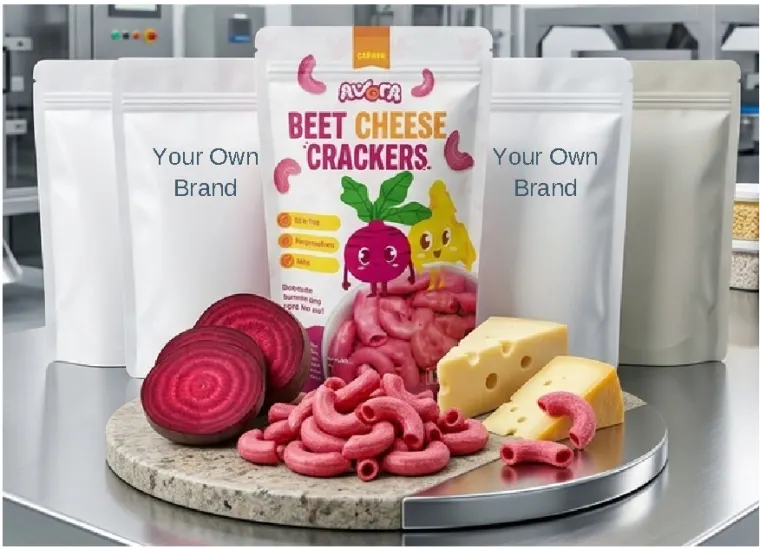
If you are building your own brand, the pouch is one of the decisions you will make early. AVERA's private-label work covers stand-up pouches, pillow bags, bulk cartons and custom branding, alongside custom formulation of flavour, texture and nutritional profile. Formulation, weight and packaging are customisable on the Rainbow Veggie Cheese line developed for partners. You can read how these projects run on our private label page.
A sensible brief covers pack format, fill weight, target channels, any resealability or recyclability requirements and the shelf life your customers expect. Pack format also affects carton counts and freight, so settle it before you compare landed costs. Prices, MOQ, lead time and Incoterms are confirmed in each quotation rather than quoted as fixed figures, because they depend on exactly these choices.
AVERA started in a home kitchen with a simple aim: snacks that are safe, gentle and genuinely good for children. Keeping the recipe free of preservatives meant the packaging had to carry its share of the work, which is why our standard pouch is PET/ALU/LLDPE. If you would like to see how it holds up, you can request samples and full specifications from Ayu Diyan N, our Export & OEM Specialist, and judge the pack, and the crunch, for yourself.
It describes a three-layer laminated pouch. PET is the printable, scuff-resistant outer layer, aluminium foil in the middle provides the barrier against oxygen, moisture and light, and LLDPE is the inner food-contact layer that forms the heat seal.
Multi-material laminates like this are generally difficult to recycle in most current collection systems because the layers are bonded together. If recyclability is a requirement for your retailers, raise it with your supplier early, as switching materials usually reduces barrier performance and means shelf life must be reassessed.
Keep cartons in a cool, dry place away from direct sun, check for damp or crushed cartons on arrival, and avoid overstacking. Rotate stock by the batch and expiry code on each pack so the oldest stock is sold first within its shelf life.
A practical walk-through of landed cost for imported snacks, starting from real carton data and ending with a shelf price you can defend to your finance team.
Read more
Some children need to avoid gluten completely, and many families simply prefer to eat less of it. Here is how to tell the difference, read labels with confidence and choose snacks without worry or guilt.
Read more
Bright snacks are not automatically a problem, and natural colours are not automatically perfect. Here is a calm, honest look at synthetic and natural food colours, and how to read the label in the shop.
Read more